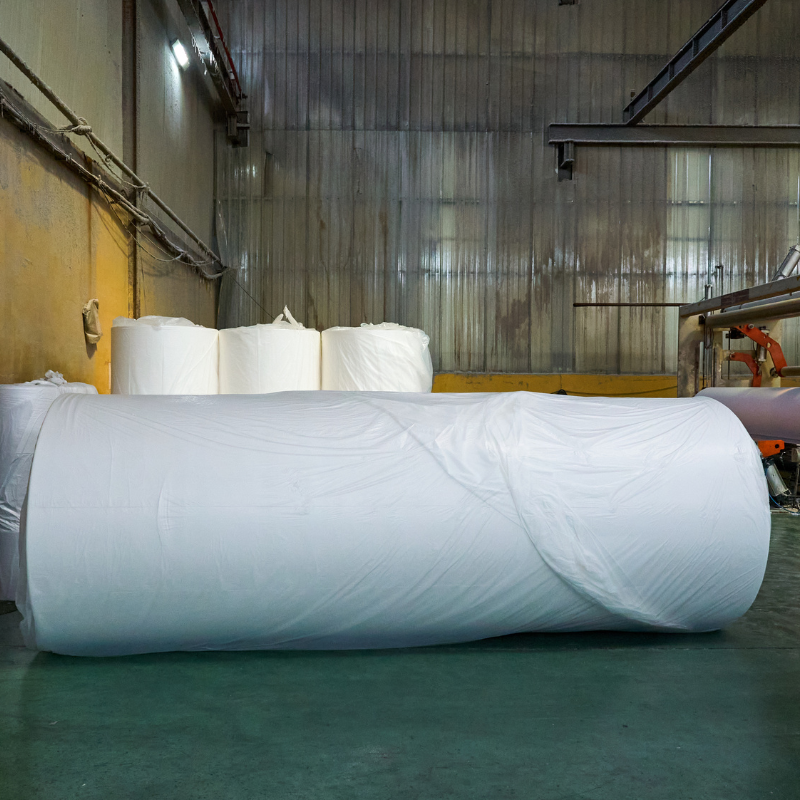
How Tissue Papers are Manufactured?
author: Vicky
2024-03-13
Tissue papers play a crucial role in maintaining hygiene standards in both homes and restaurants. They are used for various purposes such as wiping hands, cleaning surfaces, and wrapping food. Tissue papers are convenient and hygienic as they are disposable, reducing the risk of spreading germs and bacteria.
In restaurants, tissue papers are often provided to customers for wiping hands before and after meals, and they are also used by staff for cleaning tables and surfaces. In homes, tissue papers are used in bathrooms, kitchens, and dining areas to promote cleanliness and hygiene.
How Tissue Papers are Manufactured? The paper-making process can be divided into the following steps:
Raw material preparation: The main raw material of paper is plant fiber, usually wood, straw, hemp cotton, etc. are used as raw materials.The tree needs to be felled first to cut the wood into appropriate lengths, then the bark is peeled off and cut into pieces.
Pulping: Put the cut wood chips into a cooking pot for cooking. During the cooking process, add liquid medicine to decompose lignin and dissolve cellulose in the liquid-liquid. After cooking, pour the liquid liquid and cellulose solution into the pulp tank. further processing.
Treatment in the slurry tank: Add water to the slurry tank to dilute the cellulose solution, and use a screen to filter to remove impurities and residues. The slurry is then stirred to evenly distribute the cellulose.
Bleaching: In order to make the paper white, bleaching agents, such as sodium hydroxide, hydrogen peroxide, etc., need to be added to the slurry for chemical bleaching. During the bleaching process, cellulose will precipitate, and the upper layer of clean water can be discharged, and the lower layer of cellulose precipitate is pulp.
Forming: Pour the bleached pulp into a forming device, such as a paper machine. There is a grid on the paper machine, and the pulp is squeezed on the grid, and the water is gradually discharged to form a paper film. Drying: The paper film still contains a lot of moisture after being squeezed. The paper film needs to be dried or dried to reduce the moisture and gradually harden the paper.
Calendering: In order to make the paper surface smooth and increase brightness, the paper needs to be calendered after drying. The calender rolls the paper so that the fibers are more closely arranged and the surface is smooth.
Cutting: After calendering, cut the paper into the required size, such as roll, paper, flat plate, paper, etc.
Packaging: Finally, the cut paper is packaged for sale and transportation.
In addition, modern papermaking technology also includes many auxiliary processes, such as cooking liquid preparation, bleaching liquid preparation, sizing material boiling, etc. At the same time, waste liquid and waste gas will be produced during the papermaking process, which need to be treated to protect the environment.
In short, the paper production process includes raw material preparation, pulping, pulp tank treatment, bleaching and molding, drying, calendering, cutting and packaging.
What is Chlorine-Free Toilet Paper?
More About the Parent Tissue Jumbo Roll
Related Article
We are thrilled to announce our participation in the 30th China Yiwu International Commodities Fair from October 21 to 24, 2024, held at the Yiwu International Expo Center in China. We cordially invite you to visit us at our booth, located at B1-A03 and B1-A04.
Join Us at the 30th China Yiwu International Commodities Fair
The large amount of toilet paper used by Japanese people may be due to the combined influence of cultural habits, advanced toilet technology, product diversity, technological innovation and the needs of the tourism and hotel industry, environmental awareness and other factors.
Why Japanese use so much toilet paper